Black musicians own Halloween. These spooky tracks will haunt your playlist.

Share
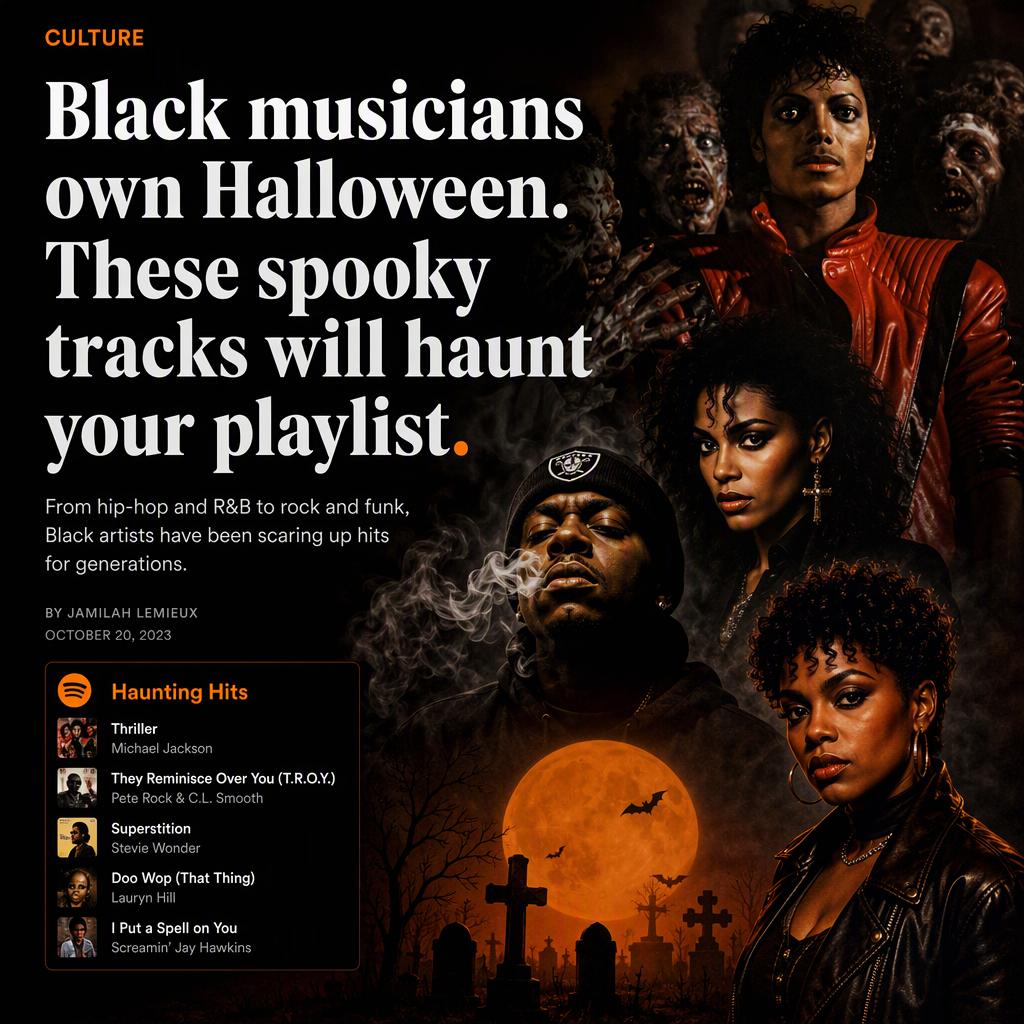
🤖 AI-generated art. Real story, imaginary pixels
🎶 Ancestral Echoes
Black musicians didn’t just ‘own’ Halloween, they architected it. From Screamin’ Jay Hawkins to Rihanna’s creeping harmonies, the genre’s soul-deep ability to channel shadows isn’t seasonal, it’s ancestral. When we talk spooky soundtracks, we’re really talking about who mastered the art of haunting and left us chasing their echoes.
🎶 Haunted Beats Built Here
Black musicians didn’t just own Halloween, they built the haunted house, wrote the soundtrack, and made you dance on the ghostly parquet floor.
🎶 Haunted By Our Sounds
Black artistry shapes how the world sounds, even in its spooky season. From haunting blues to eerie hip-hop samples, these tracks remind us that cultural ownership isn’t just about the music, it’s about the legacy. For creators, this is proof that Black innovation is eternal and genre-defining.
✨ Haunting Black Magic
Every October, the world turns its attention to spooky season, but let’s be clear: Black musicians have been haunting the culture long before Halloween playlists were a thing. When it comes to eerie, haunting, and downright supernatural music, we’ve owned this space for generations. But it’s not just about the mood. It’s about the context. Our people have always known how to spin pain, oppression, and survival into magic, and the soundtracks of Halloween are drenched in that alchemy.
Take the origins of rock and roll, for instance. The genre itself is rooted in the blues, which was never just music for entertainment. It was survival music, pain music, conjuring music. Blues pioneers like Robert Johnson didn’t just sing, they summoned. His legendary “Cross Road Blues” wasn’t spooky because of some Faustian myth slapped onto his legacy by white music historians. It was spooky because it was real. A Black man standing at the crossroads, praying for salvation, knowing he might not make it home, that’s horror. And we’ve been telling stories like that, wrapped in rhythm and melody, since forever.
” The man came out on stage in a cape, waving a skull-topped staff, growling out lyrics like a voodoo priest. He wasn’t just selling records, he was channeling the spiritual traditions that mainstream America had tried to erase. Black people have always understood that the supernatural isn’t just entertainment. It’s history, it’s survival, it’s the unseen forces we’ve had to wrestle with for centuries.
Even when you jump into more recent decades, Black artists keep innovating on the spooky and the strange. You think about Michael Jackson’s “Thriller” and how it turned the creepy into a global phenomenon. But beyond the iconic music video and dance moves, the song is a masterclass in how Black artists can take Hollywood’s glossy veneer and flip it into something far more visceral.
Even when you jump into more recent decades, Black artists keep innovating on the spooky and the strange. You think about Michael Jackson’s “Thriller” and how it turned the creepy into a global phenomenon.
Jackson wasn’t just leaning into horror tropes; he was playing with ideas about transformation, duality, and fear, all themes that hit different when you’re Black in America, where the monster isn’t always fictional.
Then there’s Grace Jones, who’s been haunting us with her otherworldly energy for decades. Her 1981 track “Walking in the Rain” isn’t about ghosts or gore, but it’s still chilling in its own way. Jones’s voice, her presence, her refusal to conform, it’s unsettling because it’s unapologetically free. Black artists like Jones remind us that sometimes the most haunting thing in the world is seeing someone embody a level of liberation you’ve been denied.
And don’t sleep on the way hip-hop dives into the supernatural. Horrorcore didn’t come out of nowhere; it grew out of the realities that Black communities were living, violence, despair, survival, and turned those nightmares into art. Think about Geto Boys’ “Mind Playing Tricks on Me,” a track that’s less Halloween and more everyday horror. The paranoia, the guilt, the trauma, it’s the stuff horror films wish they could capture, and Black rappers were doing it without the special effects.
So what does it mean that these tracks dominate Halloween playlists? It means that even when we’re not the focus of the holiday, Black creativity still drives the vibe. But it also means we need to give credit where it’s due. The spooky, the strange, the unsettling, it’s not just Black music’s contribution to Halloween. It’s part of our survival toolkit, a way we’ve dealt with the unrelenting horrors of real life by spinning them into art that moves you, chills you, and makes you feel something deeper than fear.
When you’re curating your playlist this year, think about why these songs hit so hard. They’re not just fun party tracks. They’re the echoes of a people who’ve been to the brink and back, who’ve wrestled with demons, both internal and external, and turned those battles into soundscapes that still haunt us. That’s the real spell: Black music, refusing to let the darkness win. So light your candles and turn up the volume, because those songs aren’t just haunting your playlist. They’re haunting history, too.