Gunna hits FAMU homecoming 5K, pushes students to prioritize health and self-care

Share
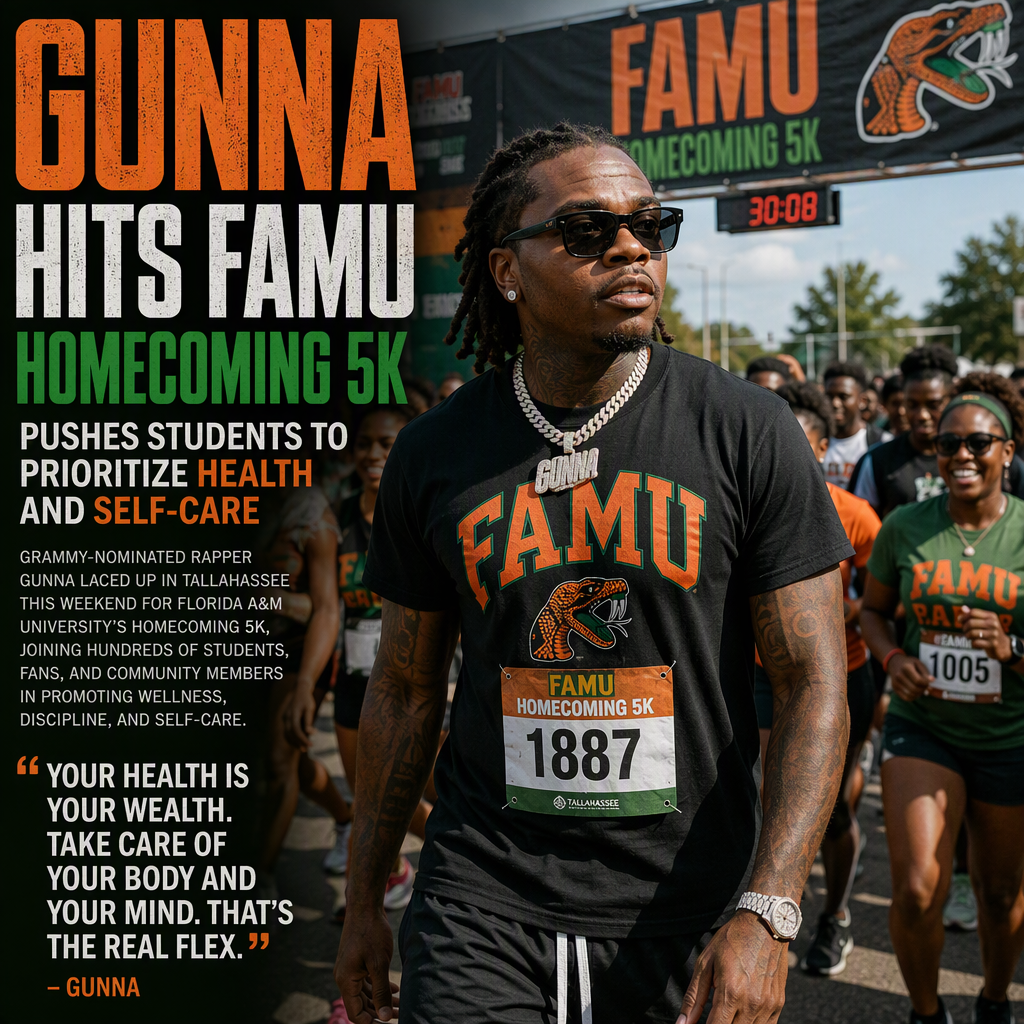
🤖 AI-generated art. Real story, imaginary pixels
🏃🏾 Run to Thrive
Gunna showed up at FAMU to remind us: self-care is not just bubble baths, it’s staying alive long enough to enjoy success. Black health is Black wealth, and his run club doubling as scholarship fuel is the kind of two-step strategy we love to see. Every mile is a message: prioritize your body, because the culture needs you here.
🌟 Wellness on Track
A rapper showing up to a college homecoming 5K to talk about health might seem like a curveball, but Gunna didn’t just lace up his sneakers for show. What he did at Florida A&M University was bigger than a jog around campus. It’s a reminder to look beyond the flashy headlines and see what’s really happening: a hip-hop artist using his platform to shift priorities in a culture where grind and neglect are often celebrated as two sides of the same coin. Gunna didn’t just pull up; he planted seeds that Black students at FAMU, and across HBCUs, need to see grow.
Let’s be real, health and wellness don’t exactly get top billing in college life, especially at an HBCU homecoming. Those weekends are a mix of tradition, reunion, and unfiltered joy, where fried fish plates and bottomless cups tend to outnumber conversations about self-care. But Gunna’s presence at the 5K flipped the script. His run club didn’t just put a spotlight on fitness. It tied it to generational uplift, backing scholarship efforts that will directly impact FAMU students. He connected health to access. And access, in our communities, is always about power.
The message hit because it’s overdue. Black folks have been told we need to “take better care of ourselves” for decades, but the structural realities that make that easier said than done rarely get addressed. Gunna’s approach didn’t preach from a pedestal; it walked alongside the students. He knows that for a lot of us, physical health isn’t just about hitting the gym or drinking water. It’s about undoing years of systems that push us toward exhaustion, whether it’s working two jobs to cover tuition, trying to navigate mental health with limited resources, or fighting generational health disparities while holding everything else together.
For Black students at FAMU, many of whom carry the weight of being the first in their families to attend college or who are working twice as hard to push past systemic barriers, the notion of prioritizing self-care can feel laughable. But Gunna showed up to remind them it’s not a luxury.
Black folks have been told we need to “take better care of ourselves” for decades, but the structural realities that make that easier said than done rarely get addressed. Gunna’s approach didn’t preach from a pedestal; it walked alongside the students.
It’s survival. Black people have been outpacing the statistics stacked against us for centuries, but the toll of that hustle is written all over our bodies. Gunna didn’t just tell these students to exercise. He showed up and ran with them, modeling the idea that caring for yourself is an act of resistance.
Look at the broader picture. We live in a time when hip-hop is often criticized for glorifying excess and escapism, but here’s an artist shifting that conversation in real time. Gunna didn’t roll through in a Bentley to flex his success. He came through with a message rooted in health, education, and community, a reminder of what success should be about. That’s not just refreshing. It’s necessary. The culture needs more of this kind of investment, where artists recognize their influence and use it to plant ideas worth nurturing.
So why does this matter for us? Because it’s bigger than a 5K. Gunna’s presence at FAMU homecoming reflects a mindset shift in the culture we build and defend every day. It’s a challenge to ask ourselves what we’re really celebrating and what kind of legacy we’re leaving behind for the next generation of Black leaders. It’s a call to push beyond just surviving and figure out what thriving could actually look like for us. If we’re really about Black empowerment, then self-care isn’t something we can afford to skip. Gunna ran to remind us: the real flex is living long enough to enjoy what we fought for.
🎤 Bars & Running Shoes
Gunna traded bars for running shoes at FAMU, proving you can drop beats and track your steps while supporting scholarships.
🌟 Influence Beyond The Mic
When an artist like Gunna uses their platform to promote health and reinvest in education, it shifts how we see celebrity influence in our community. FAMU students gain both wellness motivation and scholarship resources, showing that cultural leadership can move beyond music into tangible support for the next generation.